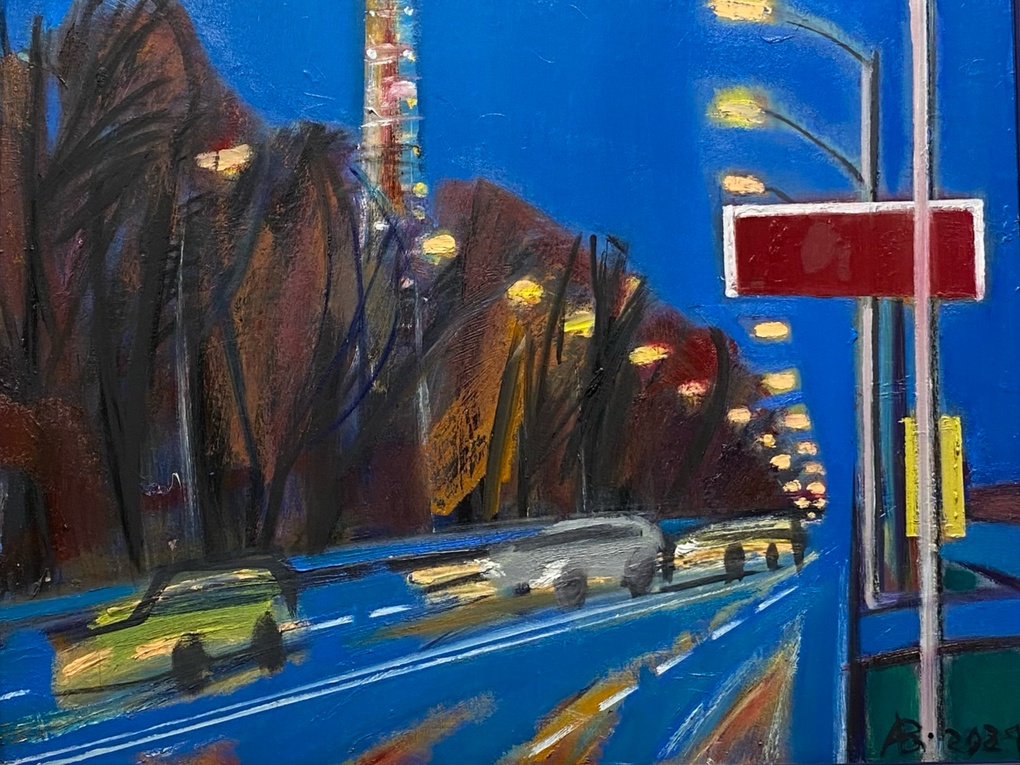
Night Avenue
Andrei VetrogonskyThis urban scene by Andrey Vetrogoński captures less a specific street than a condition of modern life: cold blue atmosphere, a chain of streetlights, and the pulse of transit turn the avenue into a metaphor of time and passage. The composition is driven by a strong vanishing perspective and the repeated cadence of luminous marks—an almost musical score in which each lamp sets the tempo, while the dark, wind-tossed trees act as theatrical wings. Cars and pedestrians are intentionally reduced to signs, heightening both the anonymity of the city and its seductive energy. A tight dialogue between saturated ultramarine and warm artificial light, reinforced by assertive brushwork and tactile paint handling, produces a sense of speed and immediacy. The blunt red road sign introduces a note of interruption—“stop” as a psychological counterpoint within an otherwise continuous flow. Market-wise, the work appeals to collectors of late modern urban lyricism and confident nocturne painting, where atmosphere and structure align with uncommon clarity.
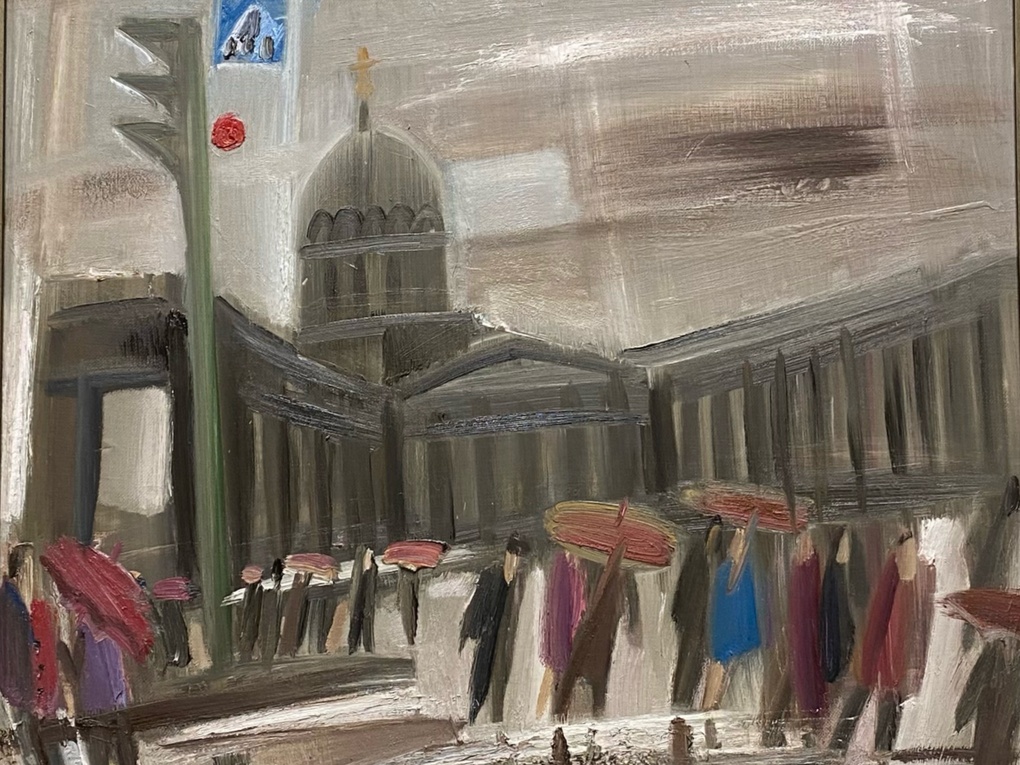
The Red
Andrei VetrogonskyThe painting depicts a rainy day in Saint Petersburg. We see the Kazan Cathedral, Nevsky Prospect, and people in motion. The artwork presents a vivid clash of two worlds: monumental architecture and a fragile human mass. At the centre of the composition stands the majestic Kazan Cathedral of Saint Petersburg: its dome with a cross and elongated façades establish an axis of authority and tradition. The recurring motif of umbrellas transforms passers‑by into a rhythmic «score» of colourful patches, creating a lively contrast to the monumentality of the cathedral. The artist deliberately avoids portraiture: figures are reduced to signs. This emphasises both the anonymity of the metropolis and, at the same time, the collective movement that seems to pulse at the foot of the historic monument. An earthy grey palette with accents of red and blue works as a form of drama. Colour here serves not a decorative purpose, but acts as a marker of presence and inner tension: the bright spots of umbrellas and passers‑by’s clothing «bring to life» the austere architectural backdrop. The gestural painting style, with visible brushstrokes and blending, creates a damp atmosphere — perhaps it is a rainy day in St Petersburg — and enhances the effect of sliding perspective, as if the city and its inhabitants are in constant motion.
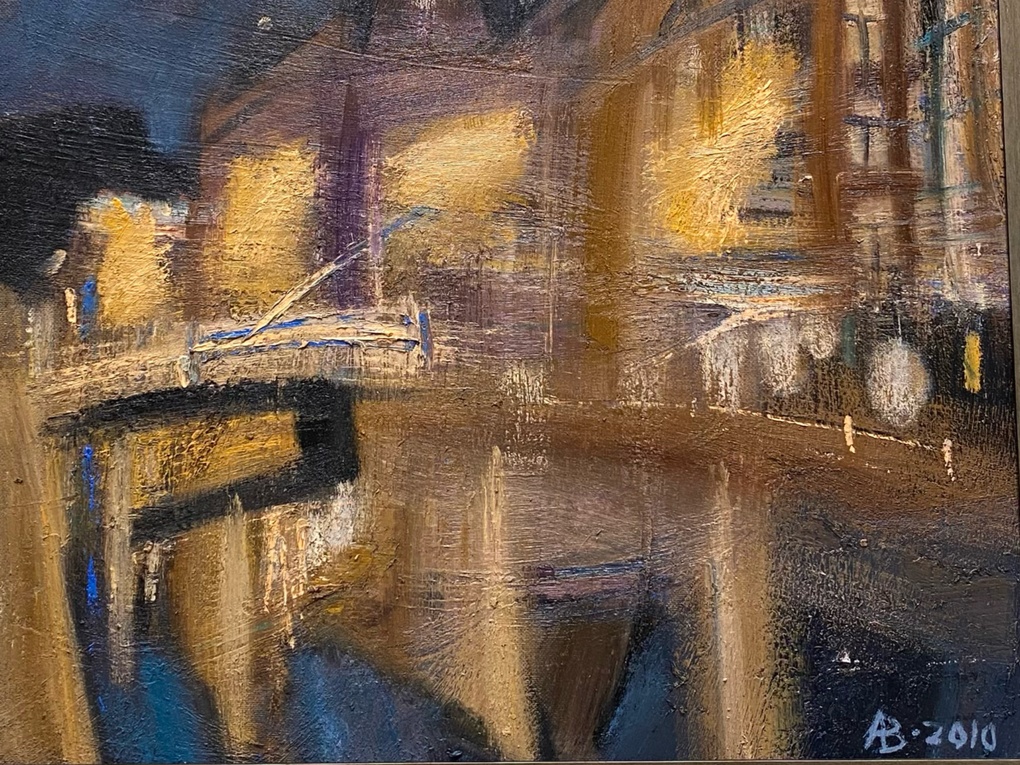
Night City: Lights and Reflections
Andrei VetrogonskyThis is a night city — not seen through the eyes of a tourist, but experienced as an inner sensation. Warm amber lights shimmer against a backdrop of cool blue shadows, creating the atmosphere of a fleeting moment: humid air, a barely perceptible movement, and a silence filled with life. The buildings and cars here are not objects, but signs. The artist does not draw a map of the city, but conveys its “psychological temperature” — something that cannot be measured, but can be felt. The surface of the canvas lives its own life: pastose brushstrokes create texture, retouches or glazes (scraping‑back effects) reveal hidden layers, and the light appears to be scratched through the paint — this is how shop windows and panes become sources of inner glow. The wet asphalt captures reflections, blurring the shapes without erasing them — on the contrary, it enhances the impression, like a memory that preserves not the details, but the emotions.
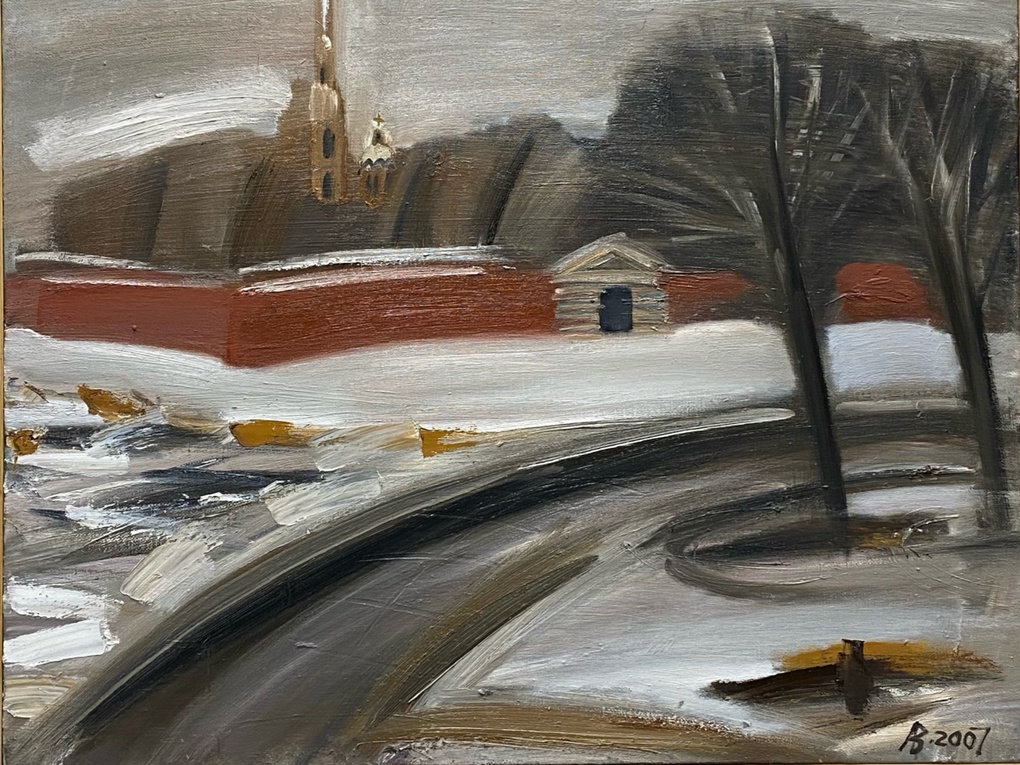
Peter and Paul Fortress in november
Andrei VetrogonskyThe painting depicts a winter cityscape executed in an expressive manner characteristic of Andrei Vetrogonsky’s work. The composition is built on a contrast between the strict geometric forms of the buildings and dynamic, slightly blurred brushstrokes that convey the movement and atmosphere of a cold day. In the foreground, a winding road covered with snow and ice is visible. Broad, energetic brushstrokes create the impression of a slippery, wet surface. On both sides of the road stand bare trees with thin, almost graphic trunks, emphasising the harshness of the winter landscape. At the centre of the composition is a small structure with a triangular roof, resembling a guardhouse or utility building. Its laconic forms contrast with a massive red wall stretching horizontally across the entire picture. The rich red colour of the wall adds warmth to the cold palette of the canvas and serves as a visual anchor for the viewer’s gaze. In the background rises the silhouette of a building with a tall tower or spire, partially obscured by grey clouds and haze. The architectural details are rendered schematically, creating a sense of depth and distance. The colour palette of the painting is restrained: grey, white, and brown tones predominate, enlivened by accents of red and yellow. Broad brushstrokes and a loose painting technique lend the work a special expressiveness and emotional intensity. In the lower right corner, the artist’s signature and date — “V. 2007” — are visible, indicating the year the work was created. The overall atmosphere of the painting simultaneously conveys the calm of a winter day and the hidden dynamism of city life, which is a hallmark of Andrei Vetrogonsky’s works.
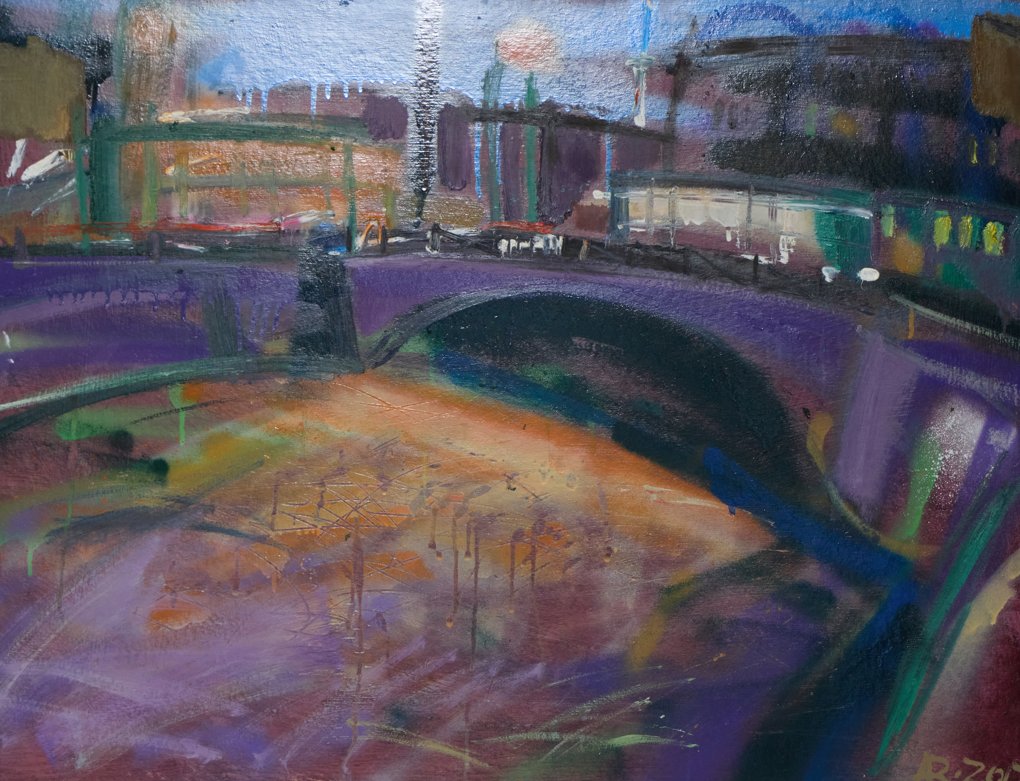
Karpovka
Andrei VetrogonskyAndrey Vetrogonsky's 2019 painting is a dynamic urban landscape rendered in an expressionist style. The canvas depicts an evening cityscape with a focus on a bridge spanning a river. Vetrogonsky employs rich purples and blues, creating an aura of mystery and intrigue. These darker tones contrast with bright highlights on the buildings and sky, adding energy and movement to the composition. The artist uses broad brush strokes and bold lines to convey the vibrancy of city life. The geometry of the bridges and buildings emphasizes urban architecture, while the color transitions create a sense of depth and space. Vetrogonsky's art, with its unique interpretation of urban environments, appeals to both contemporary art lovers and collectors looking to invest in works that combine emotional intensity with technical skill.
All 5 paintings loaded