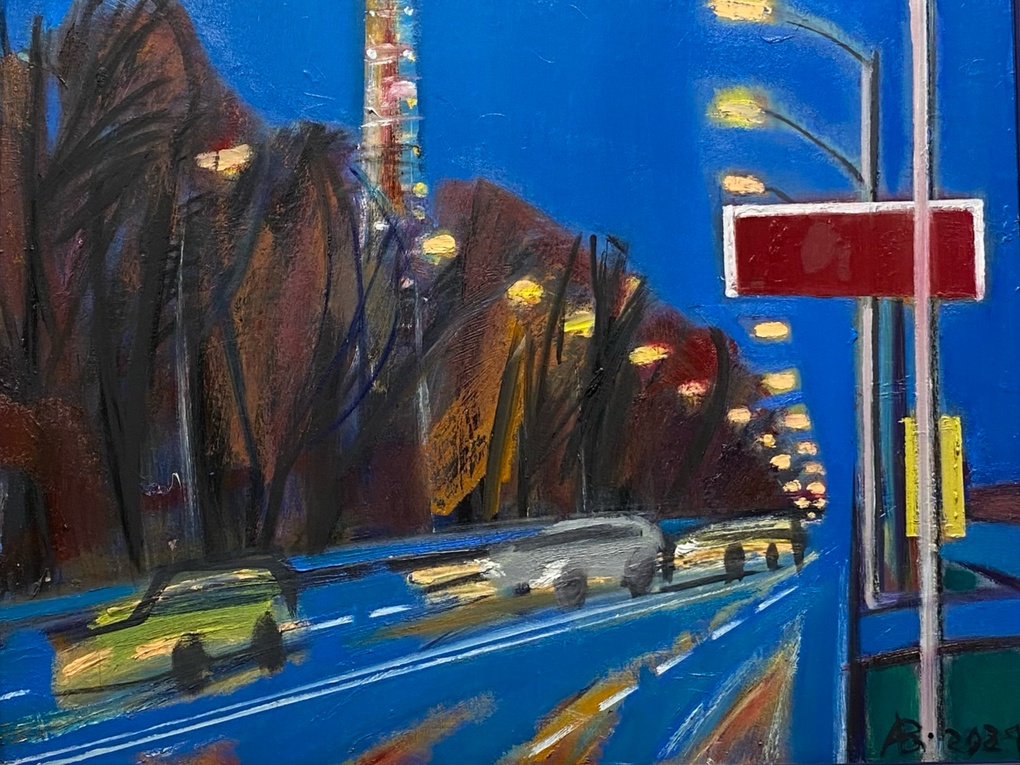
Night Avenue
This urban scene by Andrey Vetrogoński captures less a specific street than a condition of modern life: cold blue atmosphere, a chain of streetlights, and the pulse of transit turn the avenue into a metaphor of time and passage. The composition is driven by a strong vanishing perspective and the repeated cadence of luminous marks—an almost musical score in which each lamp sets the tempo, while the dark, wind-tossed trees act as theatrical wings. Cars and pedestrians are intentionally reduced to signs, heightening both the anonymity of the city and its seductive energy. A tight dialogue between saturated ultramarine and warm artificial light, reinforced by assertive brushwork and tactile paint handling, produces a sense of speed and immediacy. The blunt red road sign introduces a note of interruption—“stop” as a psychological counterpoint within an otherwise continuous flow. Market-wise, the work appeals to collectors of late modern urban lyricism and confident nocturne painting, where atmosphere and structure align with uncommon clarity.
Andrei Vetrogonsky
Born in Leningrad in 1956, graduated from the Ioganson Academic Art Lyceum, and then in 1981 from the Institute of Painting, Sculpture and Architecture named after I. E. Repin. Since 1981 a member of the Union of Artists. His works are held in the Moscow Museum of Modern Art, the State Museum of the History of St. Petersburg, the Research Museum of the Russian Academy of Arts, the Vologda Regional Art Gallery, the Murmansk Regional Art Museum, the Sakhalin Regional State Art Museum, and the Cherepovets Museum Association. His works are also included in the encyclopedia 'Three Centuries of Russian Still Life' (Lev Mochalov). Since 1976 he has participated in more than 100 exhibitions: city, regional, republican, all-union, and international. Solo exhibitions: 1989, 1994, 2001, 2007 in St. Petersburg; 2001 in Murmansk; 1990 in Clermont-Ferrand, France. The main focus of his painting is the urban landscape, particularly the rivers and canals of St. Petersburg.