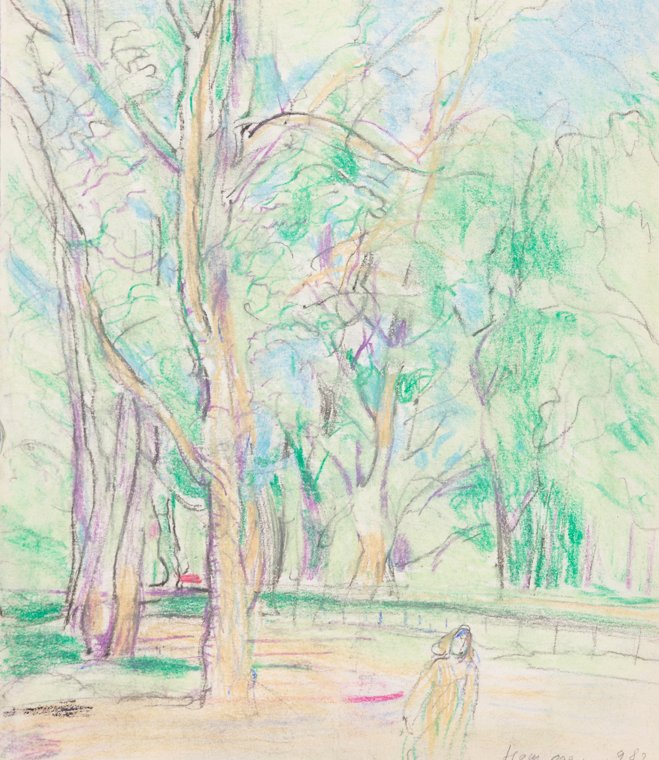
Spring Park
This delicate pastel (or colored-pencil) study captures less a specific park vista than a seasonal atmosphere—the moment when air, light, and new foliage begin to return. Tall trunks, articulated with economical line, establish a measured vertical cadence, while translucent green and blue veils of canopy suggest flickering spring luminosity. The small figure at lower right is deliberately understated, nearly dissolved into the ground; it functions as a scale marker and a quiet witness rather than a narrative protagonist. The sheet’s most eloquent device is its reliance on the paper’s whiteness, allowing space to “breathe” between winter and summer. Technique rests on soft, layered hatching and restrained chromatic accents, avoiding heavy shadow in favor of optical vibration—an approach aligned with plein-air draftsmanship and a modernist sensitivity to fleeting perception. Collector appeal lies in its intimacy and sincerity: a finished work that also reads as a first notation of seeing, well suited to cabinet collections of works on paper and thematic groupings around landscape and the poetic everyday.
Valentina Petrova
Graphic artist. In 1948 she graduated from the graphic arts faculty of the Repin Institute, defending her thesis with distinction on illustrations for V. Gorbatov's book 'The Unconquered'. Since 1948 — a member of the Union of Artists of the USSR. Since 1968 — Merited Artist of the RSFSR. She worked at Leningrad publishing houses and participated in exhibitions from 1950. She began working as an illustrator at Detgiz while still a student, and from 1950 created books in co-authorship with her husband at various publishing houses. She also had a lithographic studio where she created many autolithographs, including the 'Blockade' cycle of 1985, part of which she donated to the State Museum of the History of St. Petersburg. The large-format sheets of the cycle are a synthesis of impressions from the blockade years in a large compositional form and complex tonality. The composition 'Lecture on Art in an Air-Raid Shelter, Winter 1942' is particularly notable — it glorifies the heights of the human spirit, conveying the emotional authenticity of a time when deprivation and hunger could not prevent people from believing in beauty. Awards: Certificate of Honor from the Presidium of the Supreme Soviet of the RSFSR for creative work in book art, 30 April 1966. 1965 — Gold Medal at the Sholokhov competition at the Leipzig Exhibition. 1969 — First Prize of the Union of Artists of the USSR for a series of works about Lenin.