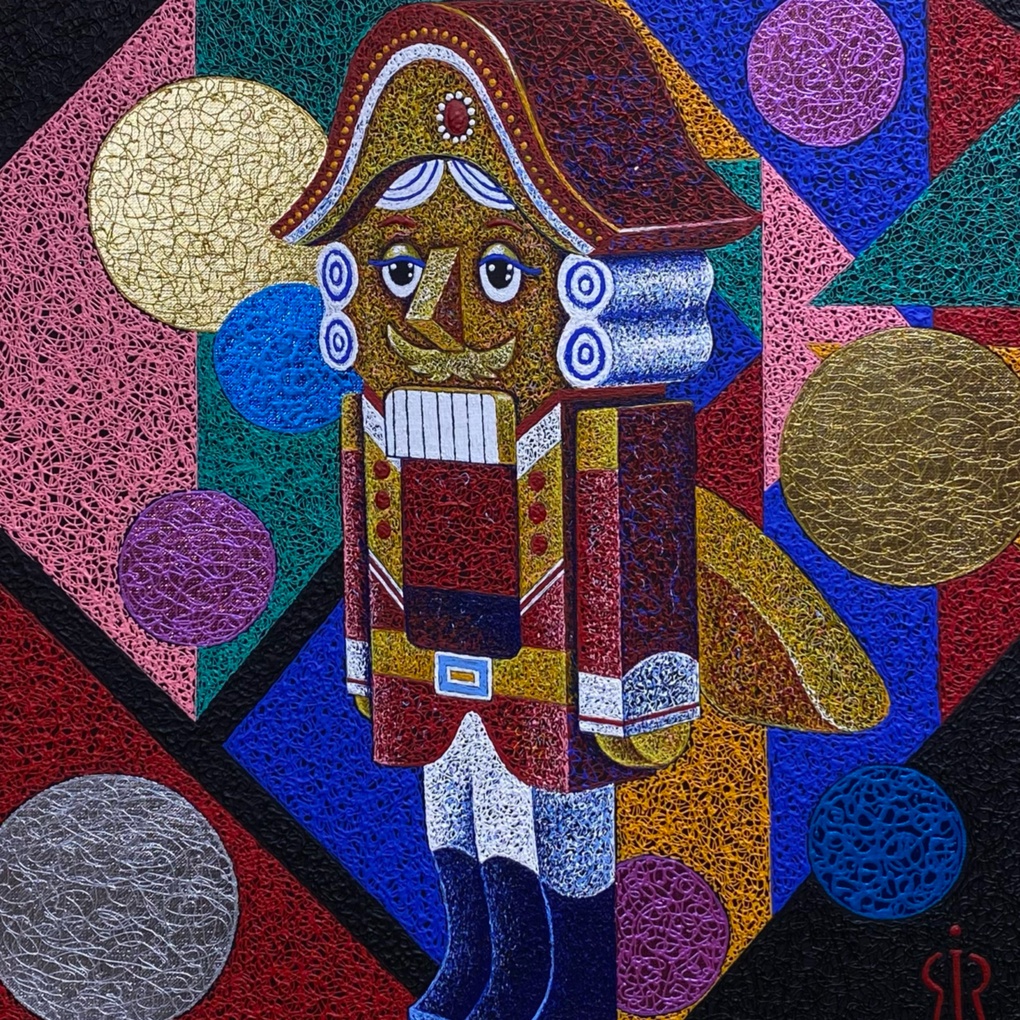
The Nutcracker: Sentinel Dream
Igor Ryazantsev’s painting The Nutcracker is a pictorial interpretation of E. T. A. Hoffmann’s famous tale and P. I. Tchaikovsky’s ballet, likely executed in oil or acrylic on canvas in a vertical format. The central focus of the composition is the transformation of the Nutcracker from a wooden toy into a noble prince, with young Marie standing beside him, frozen in admiration. The composition follows a diagonal structure: the viewer’s gaze moves from Marie in the lower left corner to the Nutcracker in the upper right, creating an upward movement that symbolises spiritual elevation. The colour scheme is based on a contrast between warm golden‑red hues (Christmas tree lights, Marie’s dress) and cool blue‑violet tones (the Nutcracker’s cloak, the background), while shimmering highlights and a light halo around the Nutcracker enhance the sense of magic. The painting technique combines smooth brushstrokes in depicting fabrics and hair with more textured, relief‑like strokes in rendering details, and the interplay of light and shadow adds dramatic tension. Through symbolic elements — the Christmas tree as an image of Christmas miracle, the faint outlines of the mouse army in the background, and a nutshell at the characters’ feet — Ryazantsev conveys the idea of transformation: faith in wonder and purity of heart have the power to change the world. The work resonates with the traditions of “fairy‑tale painting” by Russian masters such as Viktor Vasnetsov and Mikhail Vrubel, yet it is given a contemporary interpretation: it is not merely an illustration, but a reflection on the magic of childhood and the power of imagination.
Igor Ryazantsev
Igor Vladimirovich Ryazantsev (pseudonym Rene Reza—“reborn”) was born on 28 April 1965 in Tyumen. He studied painting from childhood, attended the Mitinsky Art School, then graduated from the Faculty of History at Tyumen State University, and later completed studies at the Tyumen State College of Arts and the Tyumen State Institute of Culture, specializing as an artist-restorer. In the 1990s he worked in the construction and finishing business while continuing to draw, and since 2008 has devoted himself fully to painting. He lives and works in Saint Petersburg.
He is the founder and sole representative of Filumism (from the Latin filum, “thread, fiber”), patented in 2011 (Patent No. 2436682). The Filumism technique involves extruding acrylic paint from a syringe onto a black-primed canvas: threads of paint form the image, creating the effect of an acrylic tapestry; the artist uses seven primary and three additional colors. His artistic concept is based on the interconnectedness of everything: Ryazantsev visualizes the “invisible threads” linking people, events, past, and present.
Notable works include a portrait of Grigory Rasputin (“wish-maker”); the 100-meter composition The Great Silk Road consisting of 500 paintings (each 2 × 2 meters); the Divine Comedy cycle (25 works after Dante: 9 “Inferno,” 7 “Purgatory,” 9 “Paradiso”); as well as Golden Dragon, Om, One Thousand and One Nights, The Flood, and a spherical painting designed to be viewed from multiple angles. He has participated in Russian and international exhibitions, including Salon des Beaux Arts 2017 at the Carrousel du Louvre (Paris), and in 2012 was a candidate for inclusion in the Guinness World Records in the category “One of a Kind.”