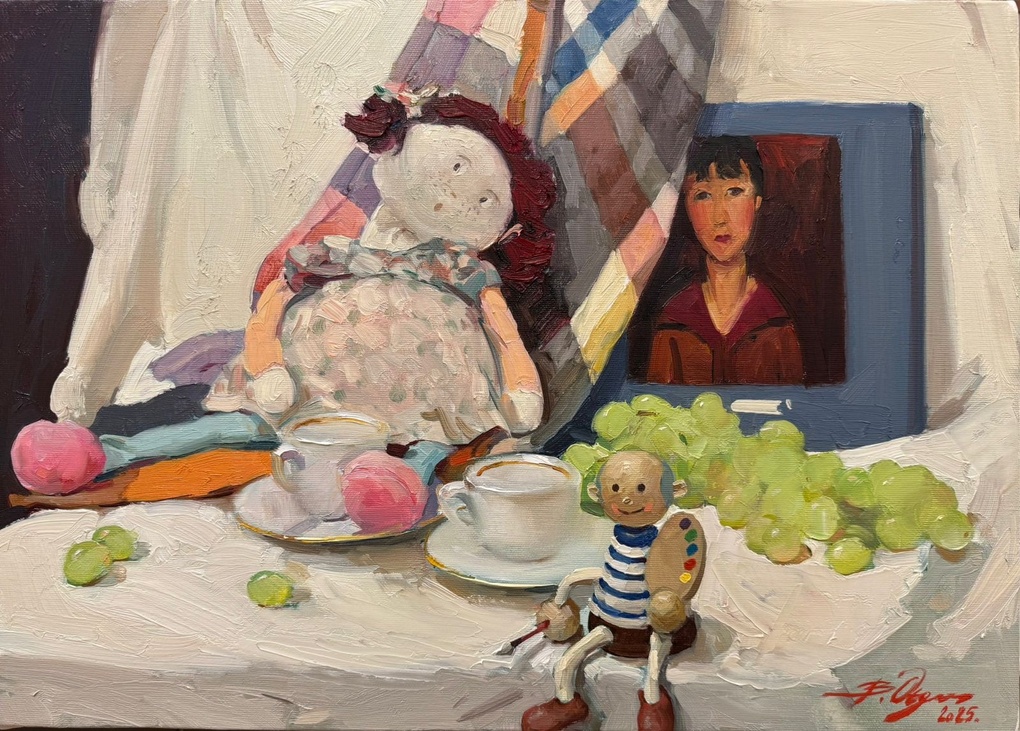
Still Life with Doll and Portrait, 2025
Toys (dolls) are a symbol of childhood, innocence, but also fragility, transience of time. They can remind you of the past, of the lost paradise of childhood. Tea cups are an association with family traditions, the warmth of the home. Grapes are a classic symbol of life, abundance, but also transience (like all fruits, it will soon deteriorate). A child's portrait is a personal, intimate element that turns a still life into a kind of "family history". A doll with a palette is a metaphor for creativity, play, imagination. It can be the image of the artist himself, who "plays" with objects, creating a new reality on the canvas. This work evokes warm, slightly sad feelings associated with memories of childhood, family comfort, transience of time. It is both simple and deep, combining everyday specifics with poetic metaphor. The artist does not just depict objects, but creates an atmosphere, invites the viewer to reflect on the meaning of things, on the connection between the past and the present.
Otgoo Badam
Otgoo Badam (born 10 September 1984, Ulaanbaatar, Mongolia) is a contemporary Mongolian artist whose practice combines academic tradition with expressive painting and national motifs. At the age of 12 he won first prize at an international children’s painting competition in the Czech Republic—his first major recognition. From 1999 to 2002, Badam studied at the Rajiv Gandhi Vocational and Craft School, receiving a diploma in leathercraft; in 2002–2004 he studied decorative and applied arts at the Institute of Fine Arts of Mongolia. In 2003 he won a still-life competition organized by the Japanese artist Tamuki. He continued his education in 2004–2008 at the Voronezh State Academy of Arts (easel painting department), and later transferred to the Ilya Repin St. Petersburg State Academic Institute of Painting, Sculpture and Architecture (easel painting department, studio of V. S. Pesikov). In 2012 he graduated with honors and became a member of the Union of Artists of St. Petersburg. In 2013 he took part in painting an Orthodox church in Italy.
Badam’s work synthesizes academic realism, expressionism, and Mongolian national themes. His paintings are marked by energy, dynamism, and an intense sense of life, echoing the expressive power associated with Nikolai Feshin and Valentin Serov. He integrates rigorous academic technique with expressive methods, drawing inspiration from Mongolian culture as well as the traditions of Russian portraiture of the 19th–20th centuries. Key subjects include the nature of Mongolia (steppe and mountain landscapes), questions of human existence and spirituality, historical and monumental compositions, and portraits that convey the inner world of the sitter. Viewers respond to the emotional intensity of his energetic brushwork, bold contrasts, and the internal movement of his compositions. Badam is a confident colorist, employing saturated, deep tones to build atmosphere and combining warm and cool hues with nuance. He works across landscape, portraiture, and still life, and also produces historical and monumental works.
Notable exhibitions include participation in the group show “Paths and Roads” at the Central House of Artists (Moscow, 2012), a solo exhibition at Tsagaandarium Art Gallery & Museum (Ulaanbaatar, August 2012), a solo exhibition at 976 Art Gallery (Ulaanbaatar, December 2012), and a solo exhibition at the Embassy of Mongolia in Moscow at the Konosier gallery (June–July 2013). A highlight was the exhibition “Steppe Wind. Otgoo Badam” at Konosier in Moscow (6 June–5 July 2013), presenting around 50 works. Badam’s works are held in private collections in France, Belgium, Finland, China, Mongolia, and Russia, reflecting the international reach of his practice.