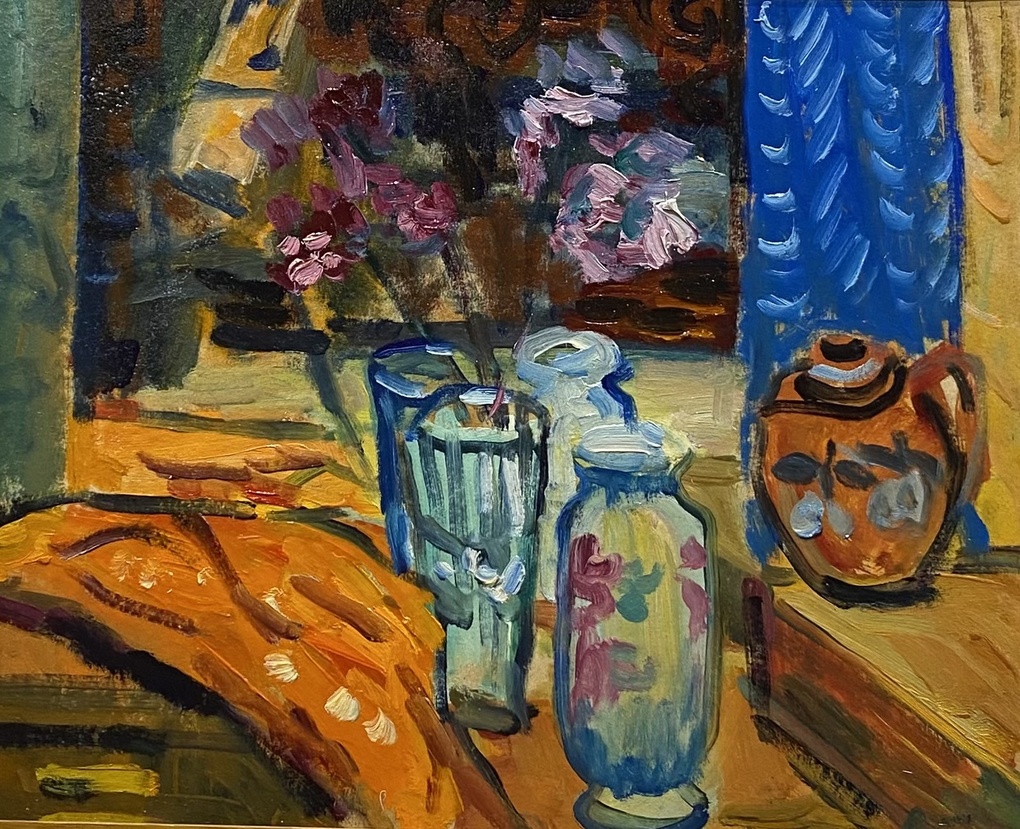
Still Life with a Blue Curtain
This painting features a cozy, vibrant still life. The artist boldly plays with colour: the warm orange seems to clash with the deep blue, while the pink flowers add a touch of tenderness. The objects — vases, a jug, a bouquet — aren’t rendered in fine detail; they appear to be built from colour patches and thick brushstrokes. Thanks to this approach, the painting doesn’t just show the items — it conveys a mood: lively, slightly agitated. In this way, the artist turns an ordinary still life into a little symphony of colours — and you want to keep looking at it over and over again. The style is expressionism with hints of Fauvism.
Alexander Irkha
Alexander Irkha was born in 1946. He lived and worked in Leningrad (later St Petersburg). The artist received a solid academic art education, either at the Vera Mukhina Leningrad Higher School of Art and Industry or at the graphics/painting faculty of the Repin Institute.
In the 1970s–1990s, Irkha became a notable figure in the Leningrad underground, associated with its “unofficial” or “quiet” wing. At that time, many artists who did not fit within the boundaries of official culture sought alternative paths, organizing apartment exhibitions and working outside the system of the Artists’ Fund. Irkha did not seek wide public recognition, yet his mastery places him alongside other significant representatives of the period.
Irkha worked in the manner of expressive realism. His style is readily recognizable for its impasto technique and thick brushwork, as well as his active use of the palette knife to create textured, almost sculptural surfaces, as though he were modelling space. He was drawn to pure, vivid, Fauvist colour. Overall, his manner represents a successful synthesis of rigorous academic draftsmanship and bold, almost rebellious use of colour.
Recurring themes in his work include an in-depth exploration of human character through sharp contrasts of light and shadow and the psychological depth of his figures; reflections on turning points in history through biblical and metaphysical questions; and the relationship between nature and humankind, with emotional states conveyed through landscape and composition. The 1970s and 1980s were a particularly active period of artistic exploration: Irkha worked within the USSR Artists’ Fund system and took part in plein-air painting trips, during which his distinctive style took shape.
Alexander Irkha’s paintings are held in private collections, including in St Petersburg.