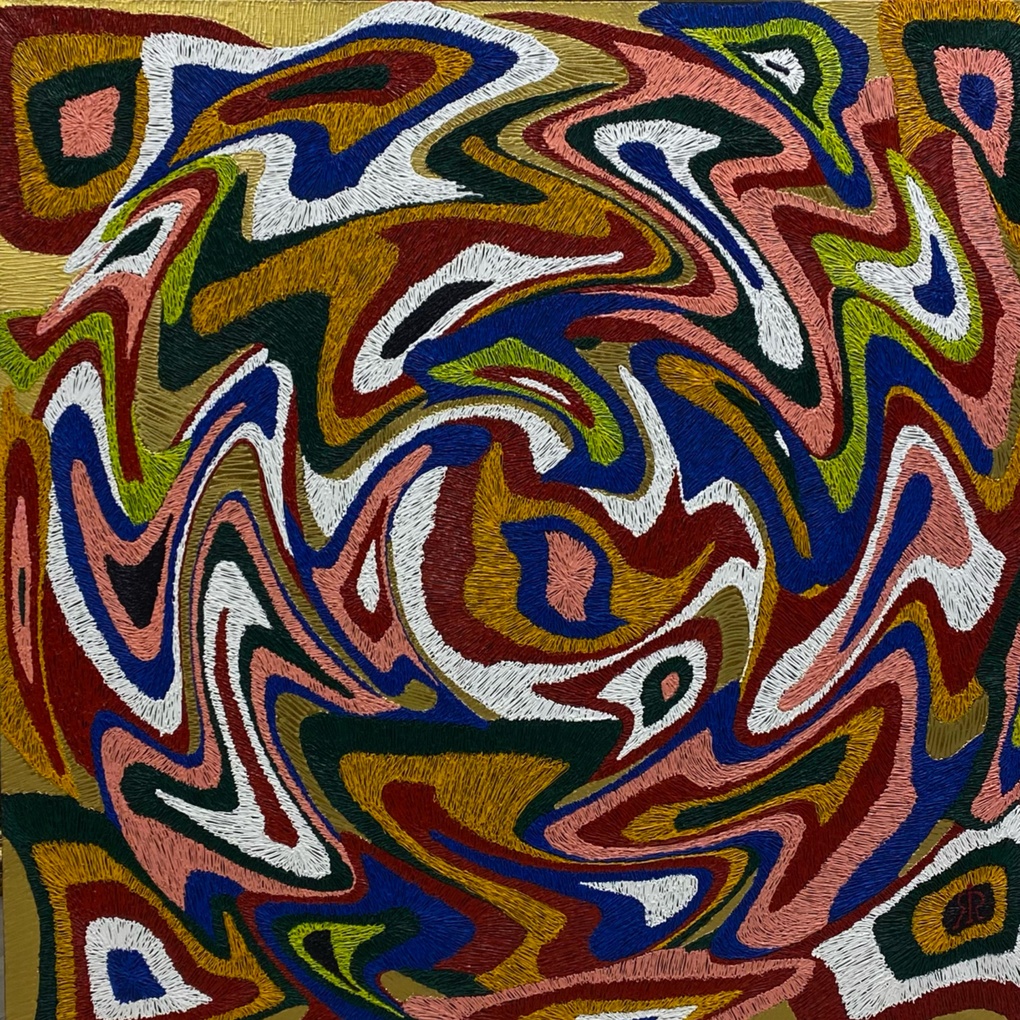
Dream
The painting captivates with its dynamic movement. At its core is a play of coloured patches that resemble islands — they contract and expand again around a certain centre, creating the impression of a map of sea currents. At first glance, the abstract forms appear similar to cross‑sections of living tissues or fragments of a mosaic. One can discern elements of folk ornaments in them, but it’s important to understand that this is not merely an illustration. The artist skillfully balances between decorative beauty and emotional depth. The distinctive feature of this work lies in its materiality. Thanks to a special technique of applying paint, each stroke resembles embroidery. Here, colour becomes not just an optical effect but a genuine material object. This creates an unusual tactile sensation — something particularly rare in abstract art. The painting’s colour scheme is built on the contrast of rich cobalt, ocher, and terracotta tones with white “slits”. This contrast establishes a special rhythm that is perceived as a pulsation — like a heart beating in tune with the work’s own rhythm. For the discerning collector, this piece represents an outstanding example of abstract art. Its value lies in the impeccable craftsmanship and energetic composition. Such a work retains its relevance regardless of fashion trends. It fits seamlessly both in a modern interior and in an exhibition space dedicated to textile art or painting.
Igor Ryazantsev
Igor Vladimirovich Ryazantsev (pseudonym Rene Reza—“reborn”) was born on 28 April 1965 in Tyumen. He studied painting from childhood, attended the Mitinsky Art School, then graduated from the Faculty of History at Tyumen State University, and later completed studies at the Tyumen State College of Arts and the Tyumen State Institute of Culture, specializing as an artist-restorer. In the 1990s he worked in the construction and finishing business while continuing to draw, and since 2008 has devoted himself fully to painting. He lives and works in Saint Petersburg.
He is the founder and sole representative of Filumism (from the Latin filum, “thread, fiber”), patented in 2011 (Patent No. 2436682). The Filumism technique involves extruding acrylic paint from a syringe onto a black-primed canvas: threads of paint form the image, creating the effect of an acrylic tapestry; the artist uses seven primary and three additional colors. His artistic concept is based on the interconnectedness of everything: Ryazantsev visualizes the “invisible threads” linking people, events, past, and present.
Notable works include a portrait of Grigory Rasputin (“wish-maker”); the 100-meter composition The Great Silk Road consisting of 500 paintings (each 2 × 2 meters); the Divine Comedy cycle (25 works after Dante: 9 “Inferno,” 7 “Purgatory,” 9 “Paradiso”); as well as Golden Dragon, Om, One Thousand and One Nights, The Flood, and a spherical painting designed to be viewed from multiple angles. He has participated in Russian and international exhibitions, including Salon des Beaux Arts 2017 at the Carrousel du Louvre (Paris), and in 2012 was a candidate for inclusion in the Guinness World Records in the category “One of a Kind.”