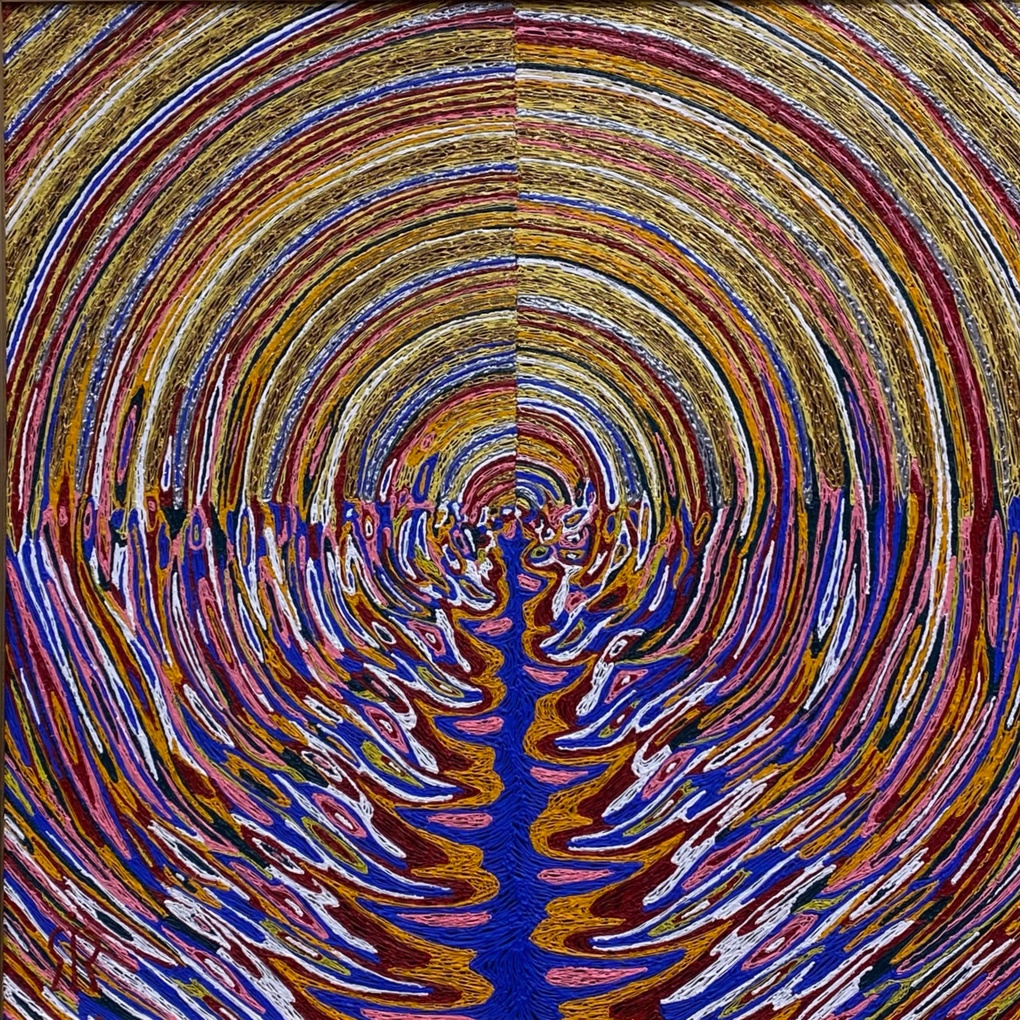
Dawn
Igor Ryazantsev’s painting Dawn is executed in the filumism technique: acrylic paint is extruded with a syringe onto a black‑primed canvas in the form of thin threads, forming a relief image with the effect of an acrylic tapestry. Through the interweaving of threads, the artist embodies his key idea of the interconnectedness of all things — the threads symbolise invisible links between people, events, past and future. Vivid shades of yellow, red and лазуритовый (lazurite/azure) convey the atmosphere of morning light breaking through the darkness, while the black background enhances the expressiveness of the colour threads. The relief surface gives the work a tactile appeal and creates a sense of movement: layers of paint form a dynamic composition, visualising the transition from darkness to light, from chaos to order.
Igor Ryazantsev
Igor Vladimirovich Ryazantsev (pseudonym Rene Reza—“reborn”) was born on 28 April 1965 in Tyumen. He studied painting from childhood, attended the Mitinsky Art School, then graduated from the Faculty of History at Tyumen State University, and later completed studies at the Tyumen State College of Arts and the Tyumen State Institute of Culture, specializing as an artist-restorer. In the 1990s he worked in the construction and finishing business while continuing to draw, and since 2008 has devoted himself fully to painting. He lives and works in Saint Petersburg.
He is the founder and sole representative of Filumism (from the Latin filum, “thread, fiber”), patented in 2011 (Patent No. 2436682). The Filumism technique involves extruding acrylic paint from a syringe onto a black-primed canvas: threads of paint form the image, creating the effect of an acrylic tapestry; the artist uses seven primary and three additional colors. His artistic concept is based on the interconnectedness of everything: Ryazantsev visualizes the “invisible threads” linking people, events, past, and present.
Notable works include a portrait of Grigory Rasputin (“wish-maker”); the 100-meter composition The Great Silk Road consisting of 500 paintings (each 2 × 2 meters); the Divine Comedy cycle (25 works after Dante: 9 “Inferno,” 7 “Purgatory,” 9 “Paradiso”); as well as Golden Dragon, Om, One Thousand and One Nights, The Flood, and a spherical painting designed to be viewed from multiple angles. He has participated in Russian and international exhibitions, including Salon des Beaux Arts 2017 at the Carrousel du Louvre (Paris), and in 2012 was a candidate for inclusion in the Guinness World Records in the category “One of a Kind.”