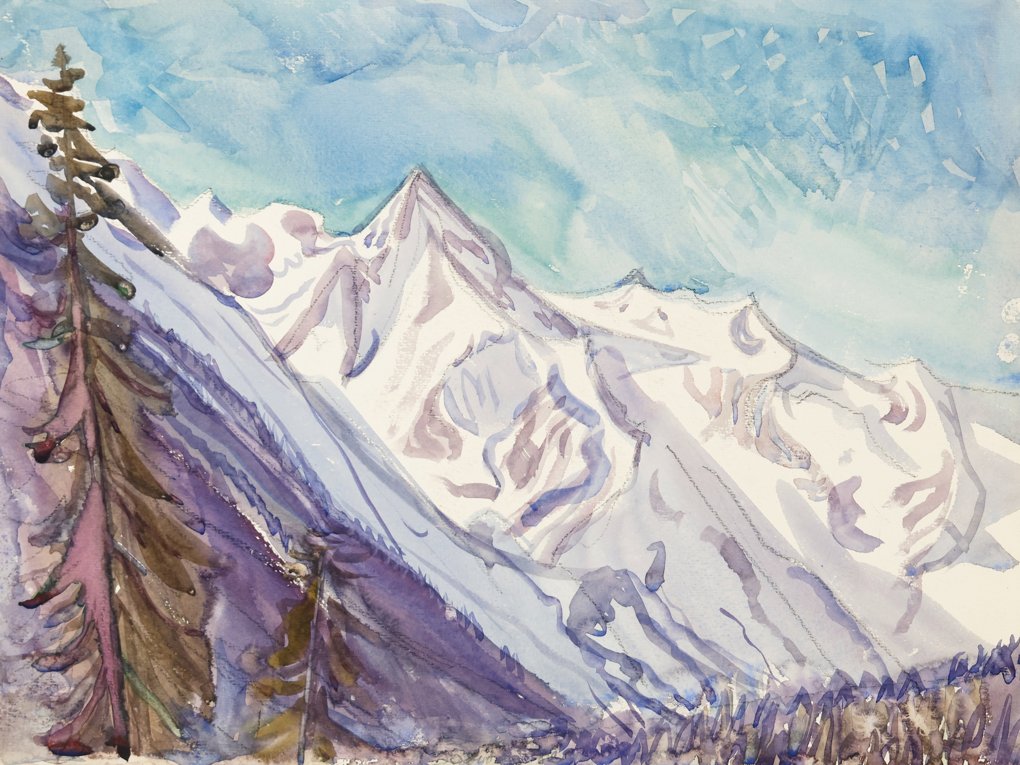
Snowy Peaks
This watercolor mountain scene is built on the tension between crystalline whites of snowfields and a cool, luminous sky, where transparent washes evoke altitude and thin air. The composition is anchored by a diagonal ridge and the vertical presence of dark conifers in the foreground—an intentional measure of scale that both humanizes and dramatizes the remoteness of the peaks. The artist strategically preserves areas of bare paper, letting the sheet itself become light and snow, a collector-respected approach for its technical risk and irreversibility. Violet-gray shadowing and controlled blooms suggest wet-on-wet passages tempered by dry, decisive accents along the glacial contours, sharpening the sense of icy architecture. Beyond its immediate visual appeal, the work sits comfortably within the market’s steady appetite for intimate yet expansive alpine imagery: it is highly adaptable to contemporary interiors and speaks to collections interested in watercolor virtuosity, plein-air sensibility, and nature as a symbol of endurance and clarity rather than narrative illustration.
Valentina Petrova
Graphic artist. In 1948 she graduated from the graphic arts faculty of the Repin Institute, defending her thesis with distinction on illustrations for V. Gorbatov's book 'The Unconquered'. Since 1948 — a member of the Union of Artists of the USSR. Since 1968 — Merited Artist of the RSFSR. She worked at Leningrad publishing houses and participated in exhibitions from 1950. She began working as an illustrator at Detgiz while still a student, and from 1950 created books in co-authorship with her husband at various publishing houses. She also had a lithographic studio where she created many autolithographs, including the 'Blockade' cycle of 1985, part of which she donated to the State Museum of the History of St. Petersburg. The large-format sheets of the cycle are a synthesis of impressions from the blockade years in a large compositional form and complex tonality. The composition 'Lecture on Art in an Air-Raid Shelter, Winter 1942' is particularly notable — it glorifies the heights of the human spirit, conveying the emotional authenticity of a time when deprivation and hunger could not prevent people from believing in beauty. Awards: Certificate of Honor from the Presidium of the Supreme Soviet of the RSFSR for creative work in book art, 30 April 1966. 1965 — Gold Medal at the Sholokhov competition at the Leipzig Exhibition. 1969 — First Prize of the Union of Artists of the USSR for a series of works about Lenin.